A record year — and a structural paradox
India added roughly 50 GW of renewable energy capacity in 2025 alone, backed by approximately $22.3 billion in investment — the single largest annual deployment in the nation's history. Non-fossil sources now account for 52.3% of India's installed capacity, hitting the 50% milestone five years ahead of schedule. As of January 2026, the country's total installed power capacity stands at 520.5 GW, with 272 GW from non-fossil sources.
Yet the numbers conceal a fundamental tension. While renewables hold majority capacity share, they contribute only about 25% of actual electricity generation. The remaining 75% still comes from coal. A 1 GW solar farm generates electricity for 4–5 peak hours daily; a coal plant runs 18–20 hours. This capacity-generation paradox is the central riddle of India's energy transition — and the stakes are global.
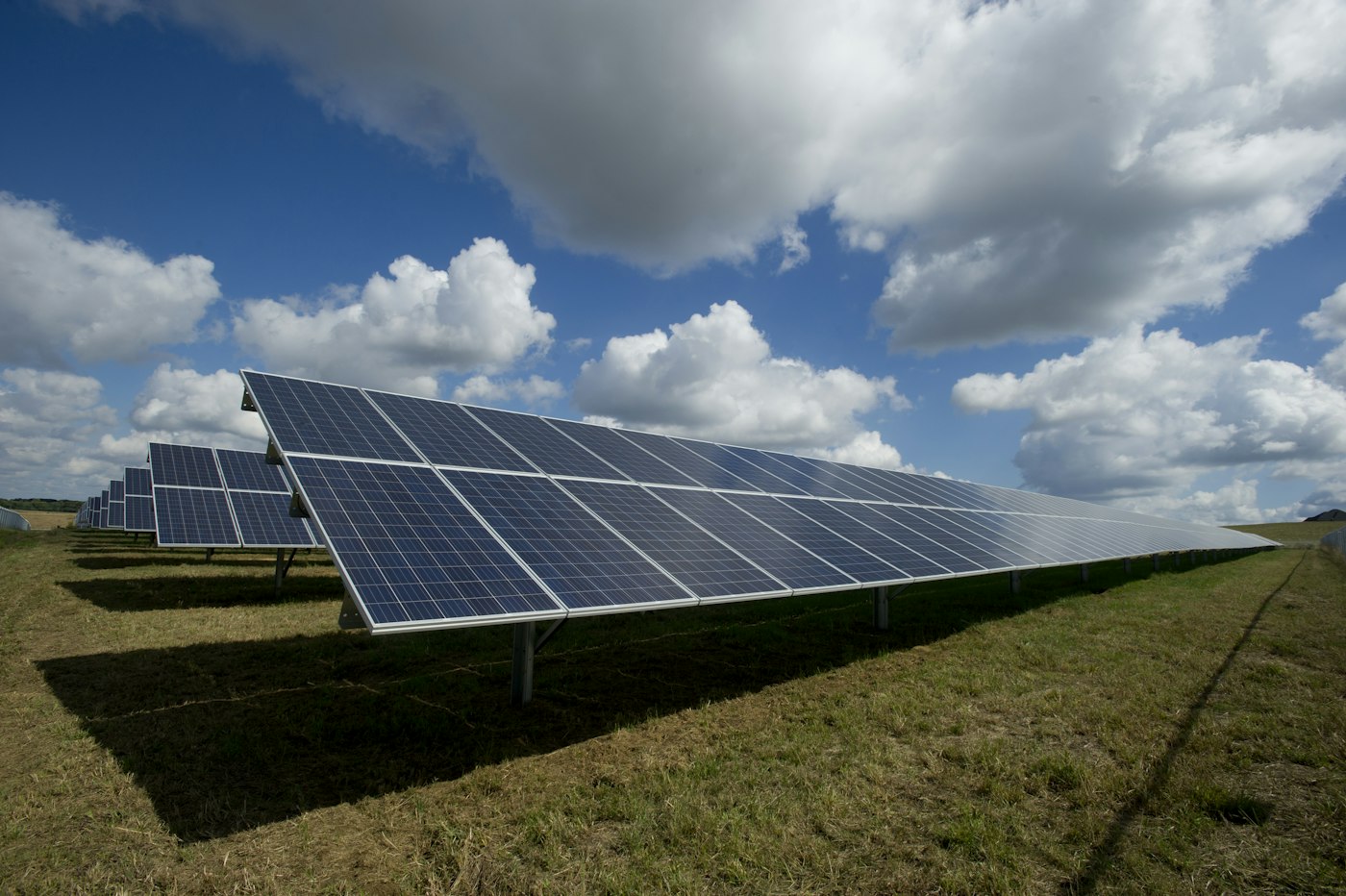
From 140 GW of solar to a 500 GW non-fossil target
India's renewable portfolio now stands at 272 GW: solar leads at 140.6 GW (53% of all renewables), followed by wind at ~55.6 GW, large hydropower at ~53.7 GW, biomass at ~11.6 GW, and nuclear at 8.78 GW. The acceleration has been dramatic — India added 29.5 GW of renewables in FY 2024-25, then approximately 50 GW in calendar year 2025.
The headline target — 500 GW of non-fossil capacity by 2030, announced at COP26 — requires adding roughly 228 GW in four years, or about 57 GW annually. That pace looked implausible two years ago but appears increasingly achievable. A pipeline of 169.4 GW in projects under implementation and another 65 GW already tendered supports the optimism. Beyond 2030, India's intermediate climate commitments include reducing emissions intensity by 45% over 2005 levels (projections suggest 48–57% reduction) and a long-horizon net-zero target by 2070.
Landmark projects reshaping the energy map
1.47 billion people, a young workforce, and surging urbanization
India formally surpassed China as the world's most populous nation in April 2023, at approximately 1.426 billion people. As of early 2026, the population stands at roughly 1.472 billion, growing at 0.88% annually — adding ~12.9 million people per year. China's population, by contrast, peaked in 2022 and is now declining.
India's total fertility rate has fallen below replacement level to approximately 1.9 children per woman, down from 5.9 in 1950. The UN projects India's population will peak at approximately 1.69–1.70 billion in the early 2060s, then gradually decline. A significant north-south demographic divide persists: Kerala's TFR is 1.6 while Bihar's exceeds 3.1.
Three demographic forces directly amplify energy demand. Urbanization — currently at ~37.6%, projected to reach 50–56% by 2050, adding an estimated 300 million urban residents by 2030. The demographic dividend — 68% of India's population (roughly 1 billion people) is working age, with a median age of just 28–29. And rising incomes — India sold a record 14 million air conditioners in 2024 alone, with cooling demand projected to add 140 GW of peak load by 2030.

Industrial expansion: the biggest driver of electricity growth
India's economy is growing at 6.5–7.4% annually, making it the fastest-growing major economy globally. The country became the world's fourth-largest economy in mid-2025, surpassing Japan, and is projected to reach $7.3 trillion GDP by 2030. Industry already consumes 41.8% of India's electricity — the largest sectoral share.
The Production Linked Incentive (PLI) scheme — ₹1.97 lakh crore across 14 sectors — has attracted ₹1.76 lakh crore in realized investment and generated over 12 lakh jobs. Semiconductor fabs, EV battery plants, solar module factories (India now has 120 GW of module manufacturing capacity), and data centers are among the most energy-intensive facilities being built.
Total electricity consumption reached approximately 1,694 TWh in FY 2024-25 and is projected to reach 2,474 TWh by FY 2031-32 — a 46% increase in seven years. The IEA projects India will add more than 570 TWh to annual consumption by 2030, equivalent to the entire current electricity consumption of France.
Geopolitics, investment, and the coal question
India is simultaneously pursuing two contradictory strategies. On the clean energy side: record deployment, a 4:1 clean-to-fossil investment ratio in the power sector (up from 1:1 in 2015), and clean sources growing 3x faster than demand in H1 2025. On the coal side: 35 GW of new supercritical coal plants under construction, plans for up to 97 GW of additional coal capacity by 2035, and reports that India may expand coal through 2047 to a total of 420 GW.
The economic case against new coal is strengthening. New coal tariffs (₹5.38–6.30/kWh) already exceed firm renewable energy costs (₹4.98–4.99/kWh). Coal generation fell 3% in 2025 — only the second annual decline in half a century. But three critical infrastructure gaps prevent renewables from displacing coal faster.
Policy & geopolitical milestones
Clean vs. fossil investment — a tipping ratio
■ Clean Energy ■ Fossil Fuel
Major financing flows into India's transition
Can India outrun its demand curve?
The IEA frames India as the country with the largest absolute increase in global energy demand through 2035 — surpassing even China's comparable development phase. Under the Stated Policies Scenario, solar and wind generation rises from 11% to 25% of India's total by 2030 and 40% by 2035, while coal demand plateaus.
A simplified buildout-versus-demand calculation illustrates the challenge. India's peak electricity demand is projected to reach 366 GW by FY 2031-32, up from ~250 GW in June 2025. If India adds 50–57 GW of non-fossil capacity annually, it can plausibly approach the 500 GW target while total capacity grows to 700–750 GW. But achieving even 25–30% generation share from non-fossil sources requires a storage and grid revolution, not just more panels and turbines.
Every percentage point of GDP growth, every new air conditioner, every new data center and factory adds to a demand curve that renewables must not just match but exceed if coal is to meaningfully decline. India's per capita consumption at 1,395 kWh — a fraction of the developed-world norm — practically guarantees that total demand will continue climbing steeply for decades. The renewable buildout is real, accelerating, and historic. Whether it's fast enough is the question that will define the next quarter-century of global energy and climate policy.
Works Cited
Asian Development Bank. "ADB and GCF Partner to Launch Clean Energy Financing Program in India." ADB News, 2025. adb.org.
```Centre for Research on Energy and Clean Air. "India Power Sector Review 2025: Record Clean Energy Deployment Drives Historic Decline in Coal Generation." CREA Publications, 2025. energyandcleanair.org.
Climate Action Tracker. "India." Climate Action Tracker Country Profiles, updated 2025. climateactiontracker.org.
Council on Energy, Environment and Water. "India Must Aim for 600 GW of Clean Energy by 2030." CEEW Press Release, 2025. ceew.in.
Council on Energy, Environment and Water. "India on Track to Exceed 2030 NDC Target on CO₂ Emission Reduction." CEEW Press Release, 2025. ceew.in.
DD News. "India Adds Record 44.5 GW Renewable Energy Capacity in 2025: Govt." DD News, December 2025. ddnews.gov.in.
DD News. "India Accelerates Nuclear Power Expansion in Union Budget 2025-26." DD News, 2025. ddnews.gov.in.
Ember. "Coal's Diminishing Role in India's Electricity Transition." Ember Latest Insights, 2025. ember-energy.org.
Ember. "RE-Powering India's Heavy Industries: 20 GW Today, 24/7 Tomorrow." Ember Latest Insights, 2025. ember-energy.org.
Global Energy Monitor. "Despite a Record Year, India Needs to Double Renewables Deployment by 2030 to Meet Energy Targets." GEM Reports, 2025. globalenergymonitor.org.
GO15. "India Ahead of Its Climate Goals with 50 GW of New Renewable Energy Capacity in 2025." GO15, January 22, 2026. go15.org.
Green Hydrogen Organisation. "India." GH2 Country Profiles, 2025. gh2.org.
GreentechLead. "India Plans 97 GW New Coal Capacity by 2035 as Power Demand Surges: CEA Study." GreentechLead, 2025. greentechlead.com.
India Brand Equity Foundation. "India to Be the World's Largest Driver of Energy-Demand Growth by 2035: IEA." IBEF News, 2025. ibef.org.
Institute for Energy Economics and Financial Analysis. "India's Battery Storage Boom: Getting the Execution Right." IEEFA Resources, 2025. ieefa.org.
Institute for Energy Economics and Financial Analysis. "Production Linked Incentive Scheme Drives Robust Growth in India's Solar Manufacturing Sector." IEEFA Articles, 2025. ieefa.org.
International Energy Agency. "Demand — Electricity 2025." IEA Reports, 2025. iea.org.
International Energy Agency. "India — World Energy Investment 2025." IEA Reports, 2025. iea.org.
International Trade Administration. "India — Renewable Energy." Country Commercial Guides, U.S. Department of Commerce, 2025. trade.gov.
Ministry of New and Renewable Energy, Government of India. "Physical Achievements." MNRE, 2025. mnre.gov.in.
NucNet. "Lower House Passes Landmark Bill as India Pushes Ahead with Nuclear Reforms." NucNet News, 2025. nucnet.org.
Pew Research Center. "Key Facts as India Surpasses China as the World's Most Populous Country." Pew Research Short Reads, February 9, 2023. pewresearch.org.
Press Information Bureau, Government of India. "2025 Marks Highest-Ever Renewable Energy Expansion in India's Energy Transition Journey." PIB, 2025. pib.gov.in.
Press Information Bureau, Government of India. "India's Power Capacity Hits 5.05 Lakh MW." PIB, 2025. pib.gov.in.
Press Information Bureau, Government of India. "India's Renewable Energy Capacity Achieves Historic Growth in FY 2024-25." PIB, 2025. pib.gov.in.
Press Information Bureau, Government of India. "Government Declares Plan to Add 50 GW of Renewable Energy Capacity Annually for Next 5 Years to Achieve the Target of 500 GW by 2030." PIB, 2023. pib.gov.in.
Swarajya. "India Adds Record 52,537 MW Power Capacity in FY 2025–26, Majority from Renewables; Installed Base Crosses 520 GW." Swarajya, 2026. swarajyamag.com.
United Nations, Department of Economic and Social Affairs. "India to Overtake China as World's Most Populous Country in April 2023, United Nations Projects." United Nations, 2023. un.org.
World Bank. "Reinvigorating India's Electricity Distribution for Access, Reliability, and Digitalization." World Bank Results, July 10, 2025. worldbank.org.
World Bank. "World Bank Approves Additional $1.5 Billion in Financing to Support India's Low-Carbon Transition." World Bank Press Release, June 28, 2024. worldbank.org.
Worldometer. "India Population (2026)." Worldometer, 2026. worldometers.info.
WRI India. "Understanding the IEA's 2025 Outlook for India." WRI India Perspectives, 2025. wri-india.org.
```